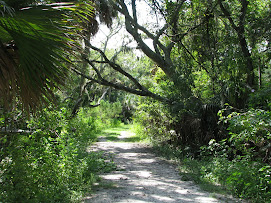
Ralph Simmons State Forest is a 3600 acre nature area located on the Florida side of the St. Marys River a couple miles east of Boulougne, Nassau County, FLA. It has 2 primary trails: the shorter one off Lake Hampton Road and the longer one off of Penny Haddock Road. Both meanders through cypress and pine forests that is typical of Nassau County and both offer views of the beautiful St. Marys River.
Showing posts with label nassau county. Show all posts
Saturday, May 9, 2015
Friday, May 31, 2013
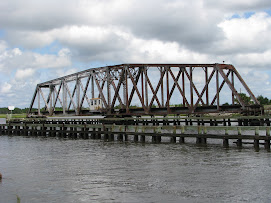
The Norfolk Southern (NS) bridge over the St. Marys River, Nassau County, FLA
The St. Marys River flows in several directions as it makes its way from Okefenokee Swamp to the Atlantic Ocean. Marked by Endicott's Mound, it begins its journey out of the Swamp in a southerly direction. It then curves eastward and cuts through Trail Ridge, a high piece of narrow ground that runs north-south from Micanopy, Florida, to the Satilla River in Georgia. The tea-colored river then hits another stretch of high ground called the Alachua ridge. It is forced to turn northward where it meanders for about 40 miles before again curving eastward. It winds for another 50 miles before making its final run as a swift, wide river that divides two barrier islands, Amelia and Cumberland. It serves as the northern and western edge of Nassau County, FLA. Three railroads cross the St. Marys:
CSX's S-Line that once was the Seaboard Air Line Railroad into Florida and is now leased to First Coast Railroad; CSX's A-line that was the Atlantic Coast Line's main line into Florida and is CSX's primary artery into the Sunshine State; and the Norfolk Southern's Georgia Southern and Florida Railroad line that ran from Macon through Valdosta to Jacksonville and is NS's main link to Jacksonville's seaports and the Florida East Coast Railway. Their respective bridge crossings were built in 1886, 1881, and 1900; each span have been rebuilt over the years on the same right of way except the ACL drawn span which was realigned to remove two sharp curves and double tracked in the first decade of the 1900s. (The old 1881 brick pillars on the Georgia side still survive in the thick wetland vegetation and the one on the Florida side serves as a central core of a water front residence.) Despite it being only 20 miles from my home, today I visited the Norfolk Southern Railway bridge across the St. Marys River. Although I am a die-hard truss span fan (like the A-line rail crossing in Boulogne) and love swing-span bridges (like the S-line rail crossing north of Yulee, although it is locked in place and can not be opened except by special permission), I have now a great admiration for this 1230 foot span that the thoroughbred engines of the NS run across every day.
The NS bridge consists of five spans: three 100-foot long steel girders and two 60-foot long girders that aren't as deep as the other three. The far eastern long girder spans the main channel of the St. Marys River which curves sharply under the span which makes traveling the waterway a bit tricky. For generations tall-mast schooners and steamships sailed up the deep St. Marys River as far as Traders Hill, Georgia, just west of Boulogne, Nassau County, FLA. This is why the other two rail bridges were swing spans at one time or the other. Since this Norfolk Southern bridge is located south of Traders Hill, thus south of the point where ships could navigate the St. Marys, there was no need for a movable span. I believe the original span was a wooden truss span, but I have not found any evidence of this.
The remains of the old wooden pilings from the first bridge jut up from the ground underneath the 2 far western long girders. When the river floods, these jagged pieces of wood are hidden under the suddenly swift currents of the tea-colored river.
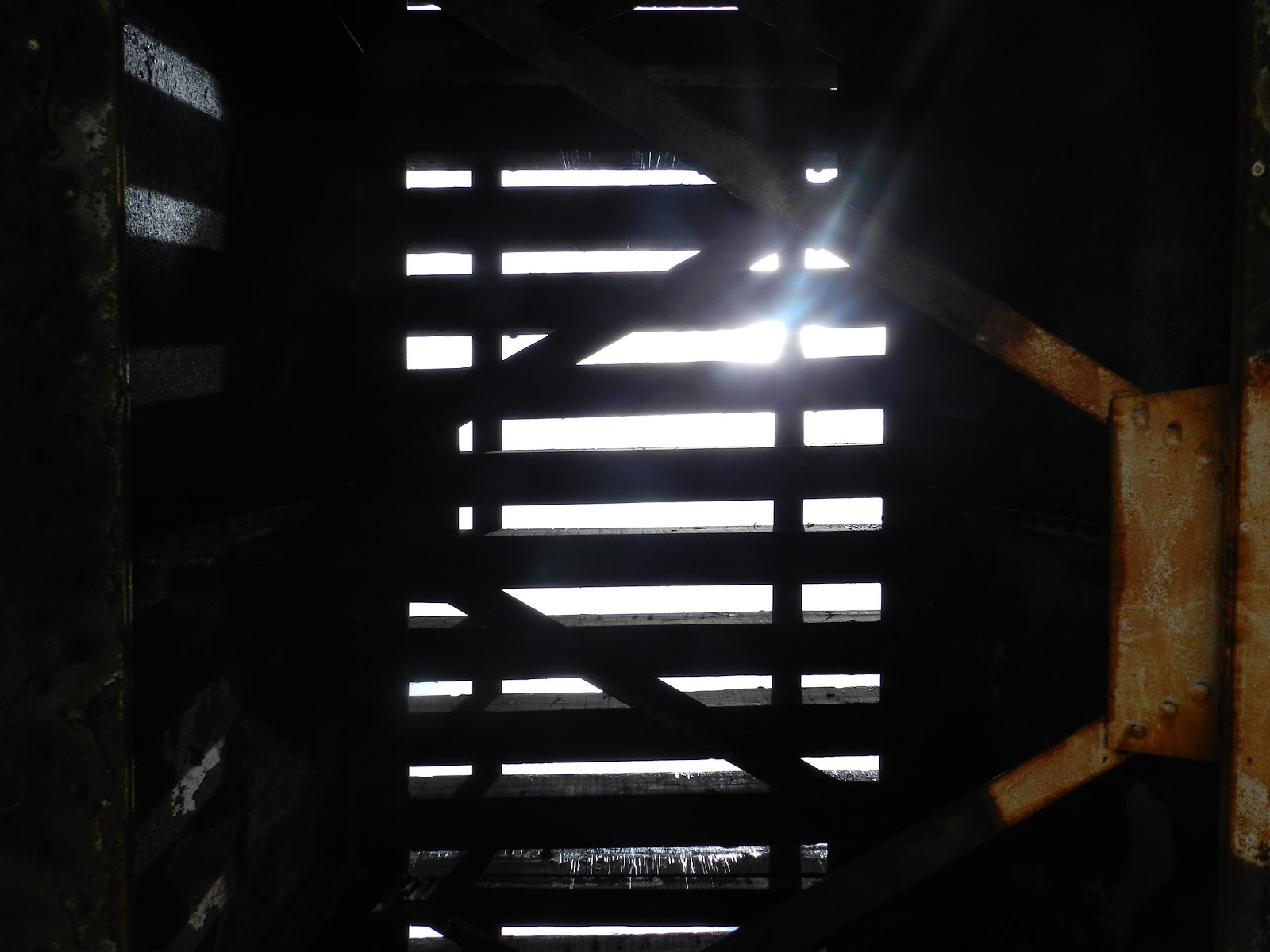
The sun peaks through the opening of the open-topped girder, exposing the cross ties and rails of the track.
At 620 feet, the western trestle approach is longer than its Florida counterpart because it has to traverse the lower flood plain on the Georgia side of the St. Marys River. It is held up by a series of massive, steel pylons.
The old wooden trestle pilings have long since been replaced by steel pylons, judging by the brown patina of the graffiti-covered I-beams.
CSX's S-Line that once was the Seaboard Air Line Railroad into Florida and is now leased to First Coast Railroad; CSX's A-line that was the Atlantic Coast Line's main line into Florida and is CSX's primary artery into the Sunshine State; and the Norfolk Southern's Georgia Southern and Florida Railroad line that ran from Macon through Valdosta to Jacksonville and is NS's main link to Jacksonville's seaports and the Florida East Coast Railway. Their respective bridge crossings were built in 1886, 1881, and 1900; each span have been rebuilt over the years on the same right of way except the ACL drawn span which was realigned to remove two sharp curves and double tracked in the first decade of the 1900s. (The old 1881 brick pillars on the Georgia side still survive in the thick wetland vegetation and the one on the Florida side serves as a central core of a water front residence.) Despite it being only 20 miles from my home, today I visited the Norfolk Southern Railway bridge across the St. Marys River. Although I am a die-hard truss span fan (like the A-line rail crossing in Boulogne) and love swing-span bridges (like the S-line rail crossing north of Yulee, although it is locked in place and can not be opened except by special permission), I have now a great admiration for this 1230 foot span that the thoroughbred engines of the NS run across every day.
The trestle approach on the Florida side is only 190 feet long as that side is part of the Alachua Ridge that runs along the western edge of Nassau County. This high ridge is what prevents the St. Marys from turning east and prevents the river's overflow from flooding the Nassau County side during heavy rains. This short trestle section is followed by the first 60-foot girder which then is connected to the 100- foot main span of the bridge.
The second 60-foot steel girder is sandwiched between the main span and another 100-foot long girder and is support by steel pilings capped with concrete. It is unclear why this girder is shorter than the rest.
The remains of the old wooden pilings from the first bridge jut up from the ground underneath the 2 far western long girders. When the river floods, these jagged pieces of wood are hidden under the suddenly swift currents of the tea-colored river.
The shadows of the girders make their own set of tracks on the ground below the bridge.To make them lighter, the girders are hollow. One the left edge of the shadow are the remains of rusty I-beams that have been cut off at ground level.
The western most long girder shares a pylon with the beginning of the Georgia half of the steel trestle.
The old wooden trestle pilings have long since been replaced by steel pylons, judging by the brown patina of the graffiti-covered I-beams.
Thursday, May 30, 2013
Work Continues on Callahan-Baldwin sub in Baldwin
Some railfan trips are eventful; others aren't so much. I started out following a SB CSX manifest train as it entered the Callahan- Baldwin Sub (milepost 20). I took a pic at mm 16 north of the Crawford diamond, but by the time I had reached Dahoma (around mm 13), the train had pulled onto the Crawford siding south of the NS diamond. I waited a bit for it or a Northbound train to come, but was denied, so I drove to Baldwin at milepost zero of the Callahan-Baldwin sub. It is in Duval County but it plays an important part the CSX network. CSX is busy double tracking the southern end of the 20-mile long Callahan-Baldwin Sub. They had closed the busy US 90/301 grade crossing to vehicular traffic, much to the frustration and display of Memorial Day weekend travelers driving on US 301. I think they are double tracking the sub up to the Fouraker siding (milepost 5) in Bryceville, Nassau County, FLA.
Looking south toward the Baldwin yard and US 301/90 grade crossing from where the Baldwin-Jax rail trail crosses at milepost 0.75. The much used Baldwin-Jax rail trail follows the old Jax and Southwestern Railroad line (J&SWRR ) from the westside of Jacksonville through Baldwin to SR 121 near Brandy Branch, Nassau County, FLA. The J&SWRR opened in 1896 and ran from the Cummer Logging Mill on the St. Johns River in Panama Park, Jax, to Newberry, FL, and the Cummer land holdings. The Atlantic Coast Line RR took over the line in 1902 and turned it into their second line from Jax to Tampa to take traffic off of their A-Line that ran from Jax to Orlando and on to Tampa. Today the trail is heavily used by cyclists, walkers and equestrians alike. One day Nassau County will connect into this very popular path.
A southbound CSX manifest train heads slowly down the Callahan-Baldwin Sub at mm 16 just north of the Crawford diamond. The new track signals added in Callahan are now operational.
Looking at the US 90/301 grade crossing where CSX is adding another track. In the background are the Baldwin yard towers and I 10 overpass.
This single track grade crossing (mm 0.15 on the Callahan-Baldwin sub) was notorious for being blocked by slow moving CSX trains leaving and entering the Baldwin yard. Traffic on US 90 had the alternative of using I 10 but those traveling US 301 had little choice but to sit and count the cars as they slowly crawled by. CSX has replaced the old gates and signals with new ones, complete with crossing arms in the median. The new signs state that there now are 3 tracks instead of one. On my next trip to Baldwin I will investigate this new configuration further south at the Oliver Street grade crossing just north of the diamond with CSX's Jax-New Orleans line.
Labels:
Baldwin,
Bryceville,
Callahan,
Callahan Junction,
Crawford,
Crawford diamond,
CSX,
nassau county
Friday, May 10, 2013
Railfanning in Keen, Nassau County, FL
When it comes to railfan hot spots in Nassau County, FL, the now-vanished hamlet of Keen (or Keene) is not among them. Yet, the Thomas Creek Road/Ratliff Road grade crossing on the Norfolk Southern Railway (NS) line just south of the Norris Siding at Keen does have its moments. Just today while traveling southbound on US 301 I spotted a southbound NS intermodal train crossing under the US 301 Viaduct at Crawford. It was doing below-average speed for an intermodal on a Friday so I veered left on Thomas Creek Road which parallels NS's Valdosta-Jacksonville line (it was built around 1900 as the Georgia Southern and Florida Railroad). It had already cleared the north end of Norris siding (not sure where that name came from) but by the time I made it to Keen, it had stopped just before the south end of the 2.3 mile long siding. I stopped next to the Thomas Creek Road grade crossing (at the intersection of Thomas Creek and Ratliff Roads) and got out. To my surprise the SB intermodal had not only stopped (intermodals are usually high balling to the ports or trying to make the Florida East Coast Railroad (FEC) connection at Bowden Yard), it stopped on the main line and not on the siding. I figured at first it was waiting on the okay to proceed onto the NS's Simpson Yard in Jacksonville then I noticed the bottom light of the NB track signal was yellow which indicated a NB train had to pass first. (The old NB track signal always had a bottom yellow-top red because of the sharp curve trains had to negotiate just before passing under the US 301 viaduct in Crawford. It only had a red bottom-red top signal when a SB train was on the line). After about a 15 minute wait I heard the faint whistle of a northbound NS train blowing at the Acree Road grade crossing just to the south of the Duval-Nassau line. I took a pic of the train (pulled by NS locomotives 8842, 9365, and 9821) as it dipped down and over the Thomas Creek trestle. I took some more as it blew its warning for the Larsen Road and Thomas Creek Roads grade crossings. The engineer waved as he slowed the locomotive down and entered the north end of Norris siding. I figured the dispatchers had him enter the siding (as opposed to having the other train wait on the siding) so that the NB could clear the main line then wait on the siding for possibly another SB train. I wanted to drive to Crawford and see if my hunch was right or if the NB slowly reentered the main line without stopping, but duty called and I had to go. However, thanks to my initial spotting of the SB intermodal, I was able to snap some good photos of the oncoming trains. Maybe I need to stop in Keen more often or split my rail fanning time between it and Crawford.
A southbound Norfolk Southern (NS) intermodal waits on the main line of the old Georgia Southern and Florida RR's (GSF) Valdosta-Jacksonville line. The yellow light on the bottom signal of the new "Darth Vader" track signal means a northbound train will soon make its way from Jacksonville.
A northbound NS trains blows its whistle as it approaches the Acree Road crossing in Duval County. The Thomas Creek trestle is at the bottom of the dip.
After crossing the short bridge and passing the Larsen Road grade crossing, the Northbound manifest train blows it whistle for the Thomas Creek grade crossing as the crossing bell chimes its impending arrival.
A southbound Norfolk Southern (NS) intermodal waits on the main line of the old Georgia Southern and Florida RR's (GSF) Valdosta-Jacksonville line. The yellow light on the bottom signal of the new "Darth Vader" track signal means a northbound train will soon make its way from Jacksonville.
A northbound NS trains blows its whistle as it approaches the Acree Road crossing in Duval County. The Thomas Creek trestle is at the bottom of the dip.
Slowing down to a near crawl, the northbound train prepares to enter the north end of Norris siding. The middle light of the track signal changed to green for a brief moment then both middle and bottom lights changed to red after the train crosses the small creek bridge and passes the track sentinel.
Sunday, April 28, 2013
Second turnout added to CSX mainline at Callahan Junction, FL
Railroad workers labor beyond both the new and old track signals as they prepare the track for the new southbound turnout onto the Callahan-Baldwin sub. This shot is looking north at the CR 108/River Road grade crossing at mm 624.37 on the A line and mm SM 19.97 on the Callahan-Baldwin sub.
The new second turnout has been added to the CSX mainline. It begins on the western track just south of the Alligator Creek trestle in between the mainline crossovers. Once it is opened, the old turnout (foreground) will be upgraded.
Looking south along the Callahan-Baldwin sub. The new second track has concrete cross ties. CSX has parked about two dozen hopper cars (in the distance) on the new track as they prepare to build the bed underneath. Workers were also preparing to activate the new track signals at mm SM 18.2 where a new cross over will be located just north of the Sandy Ford grade crossing. There is a grade difference of about 35-40 feet within the 2 mile stretch from Callahan to Sandy Ford Road. This is a great view of north bound trains coming from Baldwin as they slowing roll down the gentle grade.
Friday, March 29, 2013
Double tracking continues on CSX's Callahan-Baldwin Sub
Looks like they are adding a cross-over at around mm 17.5 of the Callahan-Baldwin sub. They have already reopened a now 4-track CR 108 grade crossing in Callahan at mm 20 at the point where it joins the CSX main line. A new over signal and a new tower signal (background) will guide trains through the junction and these crossovers. These shots are looking northbound toward Callahan from Sandy Ford Road grade crossing which is around mm 17.5 of the 20 mile long section from Callahan to Baldwin.
New signal upgrades for NS and CSX at Crawford Diamond
Both Norfolk Southern (NS) and CSX are getting darth vader signal upgrades at the Crawford Diamond 4 miles south of Callahan. This will help guard the soon-to-be busier crossing once CSX double tracks the line from Callahan to the north to the Crawford siding to the south. The new NS signal pictured in the foreground above and the CSX signal just beyond the metal control box in the background will soon direct the southbound trains for both railroads through the diamond.
A new darth vader signal for northbound NS (old Georgia Southern and Florida, GS&F) trains stands covered beside the concrete pilings for the new US 301 4-lane bridge. The new signal is located at the switch to the nearly 3-mile long Norris* siding, a major waiting point for NS trains entering their Simpson yard in Jacksonville. It is unclear what is to become of NS's overhead signals located just beyond the old two-lane viaduct. It may still be used to control traffic of trains approaching the diamond or just entering the main from the siding. There is also a small 3rd track that measures about 1000 feet just to the east of the overhead signals that is served by a ground-level signal. Once the new bridge is built, the old viaduct will be dismantled. The 200+ feet of concrete railing seen on the bridge will be removed and reset at the historic Callahan Train Depot.
* I have no idea where the name Norris comes from but I will investigate.
Looking south down the CSX Callahan-Baldwin sub from the Crawford diamond, a new signal awaits activation at the north end of Crawford Siding. A southbound CSX train waits in the background for a NB train to come up from Baldwin. Soon this siding will become part of the double track that will stretch from Callahan to hear in preparation of the funneling of more trains off the CSX A-line from Jax to Orlando that parallels US 17 to their S-line that runs parallel to US 301 form Callahan to Zephyrhills. This is partly in response to the State's purchase and conversion of CSX's line that runs through metro Orlando for a commuter line. The spur pictured above that veers off the main line runs to a large mulch manufacturing plant. There also was a spur that ran off the siding to the right side of the photo that once served a large saw mill. Looks like there is a ground level signal at this siding as well.
Tuesday, March 19, 2013
Amelia Island Trail to open May 11
The Amelia Island Trail (AIT) will officially open on Saturday, May 11, at 8:30 AM at the north trail head at Peters Point. The 6.2 mile long paved pathway parallels SR A1A from the southern tip of Amelia Island to Peters Point. Phil Scanlan, Mike Pikula, and others have been working for years with FDOT and other groups to see the bike trail to fruition. $3.2 million in funds to cover the cost of construction were provided by the North Florida Transportation Planning Office. The AIT will link with the newly open trail on Big and Little Talbot Islands to the south and tie into Eagan's Creek Greenway and pathways to American Beach and Fort Clinch. Various neighborhood schools and the local YNCA will also have links to this primary artery. The AIT is also an important segment in the larger East Coast Greenway that when completed will run 3,000 miles from Canada to Key West. Mike and Phil and others have formed the nonprofit Friends of the Amelia Island Trail to help maintain and raise awareness to this new addition to biking in Nassau County.
The primary source for this info is from the Fernandina Beach News Leader.
http://www.fbnewsleader.com/articles/2013/03/21/around_town/00attrailtoopen.txt
For more info on the AIT go to
http://www.ameliaislandtrail.org/.
The primary source for this info is from the Fernandina Beach News Leader.
http://www.fbnewsleader.com/articles/2013/03/21/around_town/00attrailtoopen.txt
For more info on the AIT go to
http://www.ameliaislandtrail.org/.
New overhead signals added to callahan junction
Looking northbound at the CSX's main line at Callahan Junction. the Callahan-Baldwin is in the background. The existing signal is giving a green light to a north bound amtrak that came barrelling by from Jacksonville a few minutes after this picture is taken.
Soon the overhead signals will be activated to guard this major junction in CSX's system.
Looking south down the Callahan- Baldwin Sub (MM 20) at a northbound manifest train waiting patiently for a northbound amtrak to clear the juntion. Soon an overhead signal will replace the antiquated one standing in front of it. The grade increases around where the locomotive is sitting from about 22 feet in Callahan to 60 feet at the Sandy Ford Road grade crossing (mm18) to about 80 at the Crawford diamond (m m15.9)
Friday, March 15, 2013
CSX continues improvements of Callahan-Baldwin sub turnout at Callahan Junction
Looking south at the Baldwin-Callahan sub from the CR 108 grade crossing in Callahan
Thursday, November 22, 2012
A NS Southbound intermodal/piggyback combo at Crawford, Nassau County, FL
A Thanksgiving treat at the Crawford diamond. A Norfolk Southern (NS) intermodal/piggyback combo heading South toward Jacksonville. There was a NB intermodal waiting on the Norris siding just south of the US 301 viaduct but I couldnt wait for that one.
Thursday, November 1, 2012
CSx southbound freight rolls through Dyal, Nassau County, Florida
Good shot of the dip in the track in between Dyal Road and Pratt Siding grade crossings.
At the bottom of the dip is the Boggy Creek trestle near where the silver spike was driven in 1881.
Saturday, October 27, 2012
Arizona Eastern 2170 does duty on the First Coast Railroad (FCRD) in Fernandina Beach
Looking north toward the port of Fernandina.
Looking south into the First Coast Railroad's Fernandina yard.
I went to a lecture in Fernandina a couple Fridays ago and caught a blue Arizona Eastern (AZER) engine pulling duty at the First Coast Railroad's Fernandina yard. AZER 2170 was pulling a manifest train from the Rock Tenn and Fernandina port that is north of the yard into the Fernandina yard. The slow-moving southbound train disappears in the yard between graffitied box cars which once was the northern terminus of the Florida Railroad.
Looking south into the First Coast Railroad's Fernandina yard.
I went to a lecture in Fernandina a couple Fridays ago and caught a blue Arizona Eastern (AZER) engine pulling duty at the First Coast Railroad's Fernandina yard. AZER 2170 was pulling a manifest train from the Rock Tenn and Fernandina port that is north of the yard into the Fernandina yard. The slow-moving southbound train disappears in the yard between graffitied box cars which once was the northern terminus of the Florida Railroad.
Work on Amelia Island Trail progressing
The AIT will parallel the Northbound lanes of SR A1A from the Grady Bridge to Fletcher Ave.
The bike trail through Big and Little Talbot Island State Parks just recently opened.
Work on the Amelia Island Trail (AIT) is progressing from the Grady Bridge at the southernmost point of Amelia Island northward to the Fletcher Avenue intersection. When finished in 2013, the off road bike trail will look much like the Talbot Island bike trail in Northeast Duval County that will south from the Grady Bridge through Little and Big Talbot Island State Parks to Ft. George and the Mayport Ferry. Together the two will form an important link in the East Coast Greenway, a national bike trail that when completed will link South Florida with New England. Funds for the AIT came from grants from the Florida Department of Transportation and the North Florida Transportation Planning Organization.
The bike trail through Big and Little Talbot Island State Parks just recently opened.
The New Grady Bridge (left) mirrors the old bridge over the Nassau Sound between Duval and Nassau Counties. One will provide the link between the AIT and the Talbot Island trails, vital parts of the East Coast Greenway.
Tuesday, September 11, 2012
Track Upgrade kicks in high gear on callahan-baldwin sub
While i was on my way to work today, i saw this unusual train today heading south on the CSX main line. It slowly exited onto the Baldwin-Callahan sub (MP 20). I drove down to Sandy Ford Road grade crossing (MP 18) and noticed a lot of CSX workers removing the old track. They also installed new train signals with Darth Vader shields several hundred yards north of Sandy Ford. I then drove to the Crawford Road grade crossing at MP 16 and took some pictures of this unusual work train spraying some kind of liquid on the tracks. (upon further research it was a LORAM rail grinder train) Rumor has it that CSX is getting ready to double track some of this 20-mile stretch of important stretch of track. (If you look close enough in the bottom picture, there is a NB manifest waiting in the distance on the Crawford siding for this LORAM to pass)
Friday, September 7, 2012
CSX works on upgrading main line in Callahan north of Baldwin turnout as two trains race by
I had a couple of spare hours today before the weather got hot so I walked to the US 301 viaduct in Callahan. CSX is doing some major work on the main line between the Old Dixie Highway and CR 108 grade crossings in Callahan. Countless dump trucks have been hauling dirt down the west bank of the double track in order to level the rail bank for a construction road. Rumor has it that they are preparing to improving the Baldwin turn out in Callahan to meet the demands of more train traffic using the Callahan-Baldwin line. They are going to straightening out that sharp curve that trains have to negotiate at such a low speed by moving it further north toward Old Dixie Highway. This will allow them to double curve the turn out as well, although I haven't hear any confirmation of this.
Luckily, while I was on top of the viaduct, 2 speeding southbound trains raced by at the same time. First a coal train appeared around the sharp curve north of the Old Dixie Hwy. grade crossing followed by a speeding Intermodal bound for the Jax Intermodal yard in Dinsmore. I will update further if I see or hear more on the CSX construction project in Callahan.
A southbound coal train rounds the bend and speeds across the Old Dixie Highway headed for one of Florida's numerous coal-hungry power plants.
Just as the coal train crosses the Alligator Creek Trestle and approaches the signals for the Baldwin turnout, an Intermodal train rounds the curve.
CSX engine 928 heads leads a trio of locomotives and its heavy load of coal cars through the CR 108 grade crossing with the Intermodal in hot pursuit.
Not to be out done, A duo of CSX engines lead by #314 races past the Baldwin turnout and one by one passes the coal-laden cars.
The US 301 viaduct shakes as both southbound trains thunder on the CSX main line below. Soon more freight trains will opt for the Baldwin turnout as the Orlando commuter trains come online in the near future.
As both trains disappear underneath the viaduct, I step across the roadway to the south side of the bridge. I caught the rear end of both trains disappear into the fog of the late summer morning. The FRED of the Intermodal finally passed the FRED of the coal train as they crossed the Pickett Road grade crossing south of Callahan.
Luckily, while I was on top of the viaduct, 2 speeding southbound trains raced by at the same time. First a coal train appeared around the sharp curve north of the Old Dixie Hwy. grade crossing followed by a speeding Intermodal bound for the Jax Intermodal yard in Dinsmore. I will update further if I see or hear more on the CSX construction project in Callahan.
Workers build a construction road on the western bank of CSX's main line just south of the Old Dixie Highway (CR 115) grade crossing in Callahan.
A southbound coal train rounds the bend and speeds across the Old Dixie Highway headed for one of Florida's numerous coal-hungry power plants.
Just as the coal train crosses the Alligator Creek Trestle and approaches the signals for the Baldwin turnout, an Intermodal train rounds the curve.
CSX engine 928 heads leads a trio of locomotives and its heavy load of coal cars through the CR 108 grade crossing with the Intermodal in hot pursuit.
Not to be out done, A duo of CSX engines lead by #314 races past the Baldwin turnout and one by one passes the coal-laden cars.
The US 301 viaduct shakes as both southbound trains thunder on the CSX main line below. Soon more freight trains will opt for the Baldwin turnout as the Orlando commuter trains come online in the near future.
As both trains disappear underneath the viaduct, I step across the roadway to the south side of the bridge. I caught the rear end of both trains disappear into the fog of the late summer morning. The FRED of the Intermodal finally passed the FRED of the coal train as they crossed the Pickett Road grade crossing south of Callahan.
Subscribe to:
Posts (Atom)