Ralph Simmons State Forest is a 3600 acre nature area located on the Florida side of the St. Marys River a couple miles east of Boulougne, Nassau County, FLA. It has 2 primary trails: the shorter one off Lake Hampton Road and the longer one off of Penny Haddock Road. Both meanders through cypress and pine forests that is typical of Nassau County and both offer views of the beautiful St. Marys River.
Showing posts with label florida. Show all posts
Saturday, May 9, 2015
Sunday, December 22, 2013
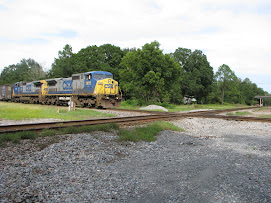
Passing CSX trains reflect Florida as a consumer state at Callahan Junction, FLA
Although we export citrus and import tourism, some can argue that Florida is a consumer state, especally after watching these two trains that passed each other at the Callahan Junction. A CSX SB train with empty coal cars clambers past a CSX SB tanker train full of corn syrup heading toward Baldwin.
Tuesday, June 11, 2013
Governor Rick Scott speaks at the Crawford Diamond Industrial Park Mega-site Certification ceremony in Crawford, Nassau County, FLA
The Crawford Diamond Industrial Park, Florida's second mega-site, was certified today in a grand ceremony attended by many federal, state and local dignitaries including Governor Rick Scott. The 1,800 acre site, owned by Rayonier's Terra Pointe, is served by two Class I railroads, CSX and Norfolk Southern (NS), which is a rarity in the State of Florida. Located at Milepost 243.7 on the NS's Valdosta-Jacksonville line and Milepost 15.6 on CSX's Callahan-Baldwin Sub, the newly certified commerce center is now one of the top industrial sites in America. Steve Reich, Executive Director of the Nassau County Development Board, and others have been hard at work getting Crawford Diamond ready and open for business. Although the first shovel of dirt has officially been turned, officials are still working in earnest in getting new businesses to relocate to the site. The site is designed to hold 10.5 million square feet of warehouse space, which will mean more trains and jobs for Nassau County, FLA. For more info, check out the link to the Florida governor's official web site below.
http://www.flgov.com/2013/06/11/governor-scott-celebrates-important-megasite-certification-in-nassau-county/?utm_source=rss&utm_medium=rss&utm_campaign=governor-scott-celebrates-important-megasite-certification-in-nassau-county
Also, a link to the story at the Fort Mills (SC) Times:
http://www.fortmilltimes.com/2013/06/11/2752276/nassau-county-industrial-site.html
http://www.flgov.com/2013/06/11/governor-scott-celebrates-important-megasite-certification-in-nassau-county/?utm_source=rss&utm_medium=rss&utm_campaign=governor-scott-celebrates-important-megasite-certification-in-nassau-county
Also, a link to the story at the Fort Mills (SC) Times:
http://www.fortmilltimes.com/2013/06/11/2752276/nassau-county-industrial-site.html
Florida Governor Rick Scott speaks to the crowd of about a hundred dignitaries and guests at today's celebration of the Crawford Diamond Industrial Park Mega-site certification.
Rayonier's President, Chairman and CEO Paul Boynton holds up the Mega-site certificates with Lindsey Myers, a representative of MaCallum Sweeney Consulting Firm at the Crawford Diamond ceremony.
Certification by MaCallum Sweeney of Greenville, South Carolina, means the 1800 acre mega site 4 miles south of Callahan, Nassau County, FLA, is open for business.
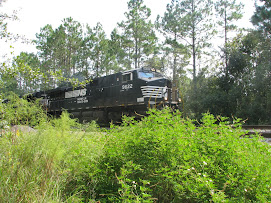
After the ceremony, Governor Scott speaks to reporters as Norfolk Southern (NS) locomotive 5826 sits in the background on the Valdosta-Jacksonville line. NS's Operation Lifesaver engine made a solo trip from Jacksonville to serve as a reminder of their commitment to the Crawford Diamond project and will vie for future rail business that the new industrial complex will bring to the area.
NS locomotive 5826 showed up from Jacksonville showed up as a backdrop to the festivities. Both NS and CSX are committed to making the Crawford Diamond succeed.
As the ceremony begins, an NS inter modal pulled by three locomotives (NS 9542 and NS 9000 and NS 2614) races by the newly certified mega-site as it approaches the Crawford diamond with CSX on it way to Jacksonville. The embankment between the track and Crawford Road had just recently been cleared of most of the trees and underbrush especially for this occasion. Plans to pave Crawford Road from US 301 in Crawford, Nassau County, FLA, westward to CR 2 and the Georgia-Florida Line has been moved up to very near future.
Friday, May 31, 2013
CSX's Callahan-Baldwin sub update from MM 0.0 to MM 20.0: May 31, 2013
Pre-fab tracks sitting at the Oliver Street grade crossing in Baldwin (MM 0.05) are waiting to be used somewhere along the 20 mile upgrade of the Callahan-Baldwin sub. In the foreground is the Callahan-Baldwin sub looking south toward the diamond with CSX's western line from Jacksonville to New Orleans. This diamond (built in late 1856 when the Atlantic and Gulf Central RR on its westward course crossed the Florida Railroad and its freshly built, southward pointing grade) use to be a single track Seaboard Air Line diamond with matching connecting tracks in all four corners. Over time the junction as changed. The turnout in the northeast corner has been removed and the turnout in the southeast corner has been double tracked to handle trains bypassing the Baldwin yard such as Amtrak. Part of the Callahan-Baldwin sub upgrade is the addition of a new connection track in the SE corner as seen in the recent update to google maps satellite view. (the existing inner turnout will be removed, leaving only 2 connection turnouts connecting the Wildwood and Jax subs) A 3-mile section of track east of Baldwin toward Jacksonville has been double tracked with a double crossover and the turnout in the southwest corner parallels the main line westward for 1.5 miles with a double crossover. The northwest turnout has remained the same for years but the prefab track in the foreground might mean they may double track this turn out. (I have found out since that the NW connection track will remain single. The prefab track will be used somewhere on the Callahan Sub) With more trains being funneled from CSX's A-line which parallels US 17 from Jax to Tampa onto their S-line that parallels US 301 from Callahan to Zephyrhills, this turnout needed to be upgraded.
Looking south from Oliver Street (mm 0.05) toward the US 90/301 grade crossing (mm 0.18). The old abandoned turnout in the northeast corner of the Baldwin diamond is just out of the right frame of the pic. Evidence of the raised bed of this turnout still can be seen where it once crossed Oliver Street. The clearing of trees and brush in the right of the picture may be evidence that CSX may reconstruct the northeast turn out again.
Looking south from the US 90/301 grade crossing (mm 0.18) in Baldwin. The crossing was just reopened an hour or two before this picture was taken for vehicular traffic. The original single track and unchanged northwest turnout to the CSX Tallahasse sub is to the right. The Baldwin diamond and yard are in the background. It appears that the new track to the far left might be the beginnings of the relaying of the northeast turnout. The middle track may either go into the Baldwin yard or connect to the bypass turnout in the southeast corner of the diamond so through trains from Callahan can bypass the yard.
A CSX manifest train with engine 461 at the point pulling engine 4314 and various freight cars through the newly reopened US 90/301 grade crossing in Baldwin. Each side has new overhead signals with digital lights that stretch over the traffic lanes. A new signal with crossing arm was added in the median so traffic is now stopped by matching crossing arms. The was already a grassy median on the eastern side but a concrete median with a matching crossing arm signal was added on the western side of the crossing.
Looking north from the US 301/90 grade crossing as the southbound freight (pictured in the previous photo) approaches from its run from Callahan. The third track (pictured in the second photo above this one) has merged into the new track shown to the right of the mainline. A new double cross over has also been added so I am sure track signals are soon to be added here.
Looking south from the Jax to Baldwin Rail Trail grade crossing (mm 0.75) toward the US 90/301 grade crossing. The grade has been widened and cleared for the second track.
Looking north from the Jax to Baldwin Rail Trail grade crossing (mm 0.75) at a new signal. The grade has been widened and cleared for the second track. This section will soon be double track to the south end of the Fouraker Siding (mm 3.6)
Looking south toward the new tri-lighted track signals (background) have been added and are in operation at the north end of the Fouraker Siding (mm 5.7). The siding, named for a pioneering family that settled the area, is relatively short by today's standards, measuring about 7500 feet. In the middle ground are the twin Brandy Branch trestles that will need to be widened if CSX is planning to double track the entire 20 mile section.
Looking north at the CR 119 grade crossing (mm 7.1) in Bryceville, Nassau County, FLA. The trestle in the foreground matches another trestle that lies in between the grade crossing and the track signals in the back ground (mm 8.7). At present there are no visible upgrades until you reach the new extension of the Crawford siding at mm 10.1 now visible in google maps.
Looking south on the Brooks Road grade crossing (mm 13.3) in Dahoma, Nassau County, FLA, at the double track extension of the Crawford siding. The new southern end of the "siding" is at now at mm 11.5, making the new double tracked section 4 miles in length. CSX has added flashing signals (with the new LED warning lights) with crossing arms at this grade crossing which is a dirt road that serves about 2 dozen families who live on the western side of the tracks.
Looking north from the Brooks Road grade crossing (mm 13.1) in Dahoma, Nassau County, FLA. The south end of the old Crawford siding ended about 1/2 mile from this crossing. The busy siding was used for southbound trains waiting to enter the Baldwin Yard and northbound trains waiting to enter CSX's A-line, the main artery out of Florida. As part of the sub upgrade, the old south end has been converted into a double crossover (mm 13.6). This section of CSX track was part of the old Florida Railroad, the Sunshine State's first trans-peninsular railroad. The 155-mile long railroad ran from Fernandina, Nassau County, FLA, (mm 0) to Cedar Key on the Gulf of Mexico (mm 155). Callahan was mm 27 and Dahoma at this curve was mm 33. Once the railroad weaved through all the swamps and creeks in Nassau County, FLA, it was able to turn southwest and make a bee line inland. This Dahoma curve is the last curve on the Florida Railroad (and Seaboard Air Line RR) until the railroad reached Waldo at mm 83.
Looking south from the Crawford Diamond, the new track signals are in operation and old ones removed at the northern end of Crawford Siding at mm 15.5, making the new double-tracked section 4 miles in length. Plans are to extend these two tracks northward to Callahan and complete the connection. The old south end of the Crawford Siding (just beyond the parked train and before the curve in the far distance) is now a double crossover, but looking at the updated satellite views on Google maps, they may be adding a third track to the west of these two existing ones. Terra Pointe's plans for building the Crawford Diamond Industrial Park in the northwest corner of the Crawford Diamond are hitting high gear therefore they may be added a new siding to this growing area of Nassau County. Link to Terra Pointe's Crawford Diamond info. http://www.terrapointeserviceslandsales.com/ViewProperty.aspx?propertyID=110
Looking east toward the Crawford Diamond, both CSX and Norfork Southern (NS) have turned on their new track signals and are removing the old ones, including these NS (foreground) and CSX (background) signals pictured here.
The new track signals are in operation at the new double crossover just north of Sandy Ford grade crossing (mm 18.5). The tracks pictured here will be extended southward and connect with the old north end of Crawford Siding, creating a double diamond at Crawford junction with Norfork Southern mm 15.7).
Looking south, new signals guard the double crossovers on the main CSX line (mm 624) just above the double turnouts to the Callahan-Baldwin sub at mm 20.0. Notice in the background there is a shy CSX northbound engine parked underneath the US 301 viaduct. It is very unusull for a train to be parked there. In fact, the engineer was backing the train up about 5 minutes before I took this photo.
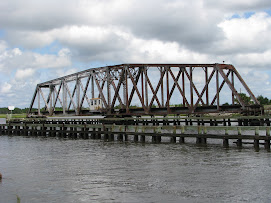
The Norfolk Southern (NS) bridge over the St. Marys River, Nassau County, FLA
The St. Marys River flows in several directions as it makes its way from Okefenokee Swamp to the Atlantic Ocean. Marked by Endicott's Mound, it begins its journey out of the Swamp in a southerly direction. It then curves eastward and cuts through Trail Ridge, a high piece of narrow ground that runs north-south from Micanopy, Florida, to the Satilla River in Georgia. The tea-colored river then hits another stretch of high ground called the Alachua ridge. It is forced to turn northward where it meanders for about 40 miles before again curving eastward. It winds for another 50 miles before making its final run as a swift, wide river that divides two barrier islands, Amelia and Cumberland. It serves as the northern and western edge of Nassau County, FLA. Three railroads cross the St. Marys:
CSX's S-Line that once was the Seaboard Air Line Railroad into Florida and is now leased to First Coast Railroad; CSX's A-line that was the Atlantic Coast Line's main line into Florida and is CSX's primary artery into the Sunshine State; and the Norfolk Southern's Georgia Southern and Florida Railroad line that ran from Macon through Valdosta to Jacksonville and is NS's main link to Jacksonville's seaports and the Florida East Coast Railway. Their respective bridge crossings were built in 1886, 1881, and 1900; each span have been rebuilt over the years on the same right of way except the ACL drawn span which was realigned to remove two sharp curves and double tracked in the first decade of the 1900s. (The old 1881 brick pillars on the Georgia side still survive in the thick wetland vegetation and the one on the Florida side serves as a central core of a water front residence.) Despite it being only 20 miles from my home, today I visited the Norfolk Southern Railway bridge across the St. Marys River. Although I am a die-hard truss span fan (like the A-line rail crossing in Boulogne) and love swing-span bridges (like the S-line rail crossing north of Yulee, although it is locked in place and can not be opened except by special permission), I have now a great admiration for this 1230 foot span that the thoroughbred engines of the NS run across every day.
The NS bridge consists of five spans: three 100-foot long steel girders and two 60-foot long girders that aren't as deep as the other three. The far eastern long girder spans the main channel of the St. Marys River which curves sharply under the span which makes traveling the waterway a bit tricky. For generations tall-mast schooners and steamships sailed up the deep St. Marys River as far as Traders Hill, Georgia, just west of Boulogne, Nassau County, FLA. This is why the other two rail bridges were swing spans at one time or the other. Since this Norfolk Southern bridge is located south of Traders Hill, thus south of the point where ships could navigate the St. Marys, there was no need for a movable span. I believe the original span was a wooden truss span, but I have not found any evidence of this.
The remains of the old wooden pilings from the first bridge jut up from the ground underneath the 2 far western long girders. When the river floods, these jagged pieces of wood are hidden under the suddenly swift currents of the tea-colored river.
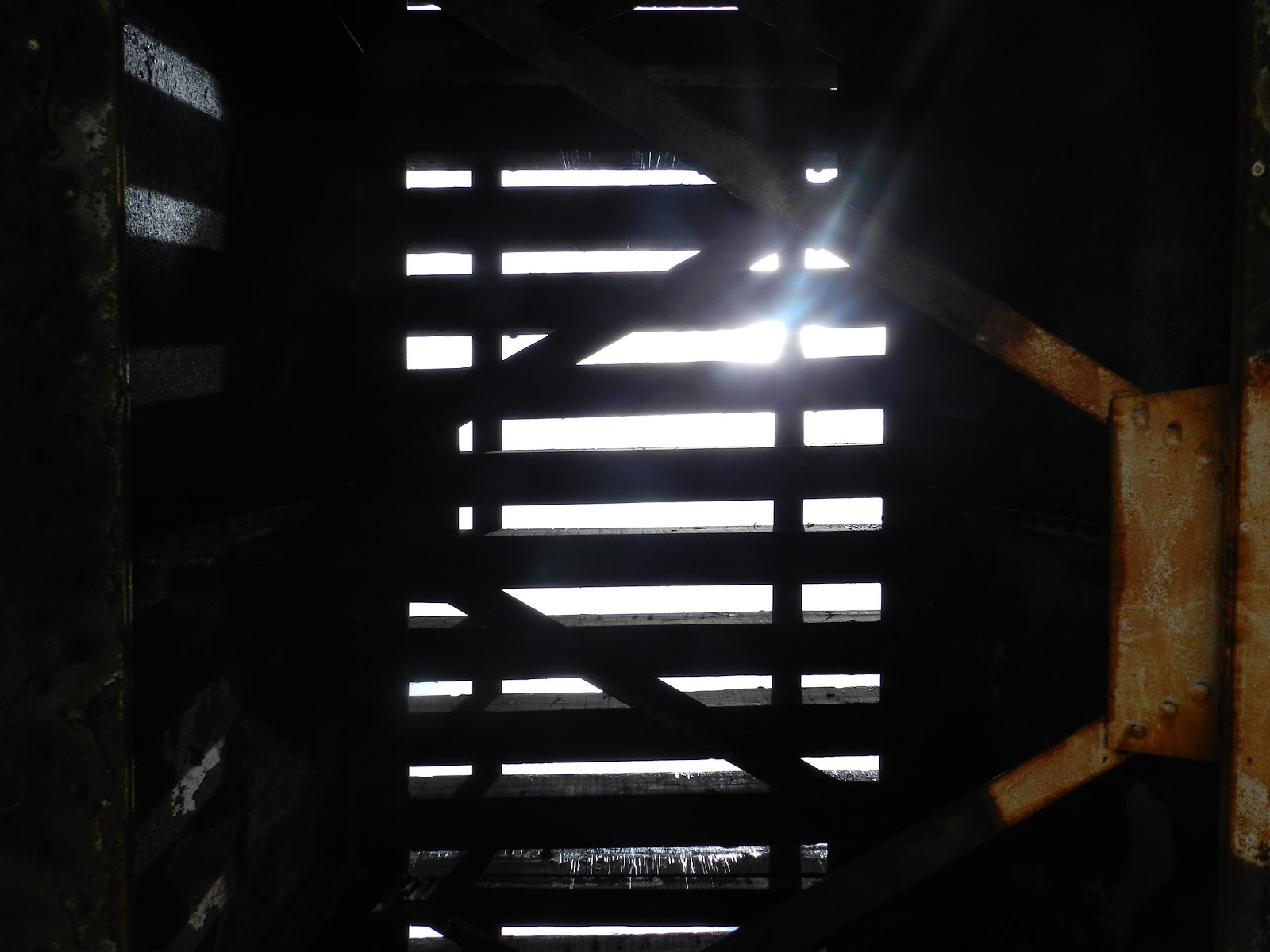
The sun peaks through the opening of the open-topped girder, exposing the cross ties and rails of the track.
At 620 feet, the western trestle approach is longer than its Florida counterpart because it has to traverse the lower flood plain on the Georgia side of the St. Marys River. It is held up by a series of massive, steel pylons.
The old wooden trestle pilings have long since been replaced by steel pylons, judging by the brown patina of the graffiti-covered I-beams.
CSX's S-Line that once was the Seaboard Air Line Railroad into Florida and is now leased to First Coast Railroad; CSX's A-line that was the Atlantic Coast Line's main line into Florida and is CSX's primary artery into the Sunshine State; and the Norfolk Southern's Georgia Southern and Florida Railroad line that ran from Macon through Valdosta to Jacksonville and is NS's main link to Jacksonville's seaports and the Florida East Coast Railway. Their respective bridge crossings were built in 1886, 1881, and 1900; each span have been rebuilt over the years on the same right of way except the ACL drawn span which was realigned to remove two sharp curves and double tracked in the first decade of the 1900s. (The old 1881 brick pillars on the Georgia side still survive in the thick wetland vegetation and the one on the Florida side serves as a central core of a water front residence.) Despite it being only 20 miles from my home, today I visited the Norfolk Southern Railway bridge across the St. Marys River. Although I am a die-hard truss span fan (like the A-line rail crossing in Boulogne) and love swing-span bridges (like the S-line rail crossing north of Yulee, although it is locked in place and can not be opened except by special permission), I have now a great admiration for this 1230 foot span that the thoroughbred engines of the NS run across every day.
The trestle approach on the Florida side is only 190 feet long as that side is part of the Alachua Ridge that runs along the western edge of Nassau County. This high ridge is what prevents the St. Marys from turning east and prevents the river's overflow from flooding the Nassau County side during heavy rains. This short trestle section is followed by the first 60-foot girder which then is connected to the 100- foot main span of the bridge.
The second 60-foot steel girder is sandwiched between the main span and another 100-foot long girder and is support by steel pilings capped with concrete. It is unclear why this girder is shorter than the rest.
The remains of the old wooden pilings from the first bridge jut up from the ground underneath the 2 far western long girders. When the river floods, these jagged pieces of wood are hidden under the suddenly swift currents of the tea-colored river.
The shadows of the girders make their own set of tracks on the ground below the bridge.To make them lighter, the girders are hollow. One the left edge of the shadow are the remains of rusty I-beams that have been cut off at ground level.
The western most long girder shares a pylon with the beginning of the Georgia half of the steel trestle.
The old wooden trestle pilings have long since been replaced by steel pylons, judging by the brown patina of the graffiti-covered I-beams.
Sunday, April 28, 2013
Second turnout added to CSX mainline at Callahan Junction, FL
Railroad workers labor beyond both the new and old track signals as they prepare the track for the new southbound turnout onto the Callahan-Baldwin sub. This shot is looking north at the CR 108/River Road grade crossing at mm 624.37 on the A line and mm SM 19.97 on the Callahan-Baldwin sub.
The new second turnout has been added to the CSX mainline. It begins on the western track just south of the Alligator Creek trestle in between the mainline crossovers. Once it is opened, the old turnout (foreground) will be upgraded.
Looking south along the Callahan-Baldwin sub. The new second track has concrete cross ties. CSX has parked about two dozen hopper cars (in the distance) on the new track as they prepare to build the bed underneath. Workers were also preparing to activate the new track signals at mm SM 18.2 where a new cross over will be located just north of the Sandy Ford grade crossing. There is a grade difference of about 35-40 feet within the 2 mile stretch from Callahan to Sandy Ford Road. This is a great view of north bound trains coming from Baldwin as they slowing roll down the gentle grade.
Tuesday, March 19, 2013
Amelia Island Trail to open May 11
The Amelia Island Trail (AIT) will officially open on Saturday, May 11, at 8:30 AM at the north trail head at Peters Point. The 6.2 mile long paved pathway parallels SR A1A from the southern tip of Amelia Island to Peters Point. Phil Scanlan, Mike Pikula, and others have been working for years with FDOT and other groups to see the bike trail to fruition. $3.2 million in funds to cover the cost of construction were provided by the North Florida Transportation Planning Office. The AIT will link with the newly open trail on Big and Little Talbot Islands to the south and tie into Eagan's Creek Greenway and pathways to American Beach and Fort Clinch. Various neighborhood schools and the local YNCA will also have links to this primary artery. The AIT is also an important segment in the larger East Coast Greenway that when completed will run 3,000 miles from Canada to Key West. Mike and Phil and others have formed the nonprofit Friends of the Amelia Island Trail to help maintain and raise awareness to this new addition to biking in Nassau County.
The primary source for this info is from the Fernandina Beach News Leader.
http://www.fbnewsleader.com/articles/2013/03/21/around_town/00attrailtoopen.txt
For more info on the AIT go to
http://www.ameliaislandtrail.org/.
The primary source for this info is from the Fernandina Beach News Leader.
http://www.fbnewsleader.com/articles/2013/03/21/around_town/00attrailtoopen.txt
For more info on the AIT go to
http://www.ameliaislandtrail.org/.
New overhead signals added to callahan junction
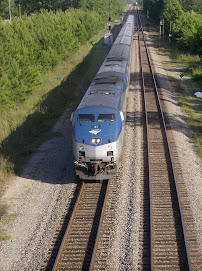
Looking northbound at the CSX's main line at Callahan Junction. the Callahan-Baldwin is in the background. The existing signal is giving a green light to a north bound amtrak that came barrelling by from Jacksonville a few minutes after this picture is taken.
Soon the overhead signals will be activated to guard this major junction in CSX's system.
Looking south down the Callahan- Baldwin Sub (MM 20) at a northbound manifest train waiting patiently for a northbound amtrak to clear the juntion. Soon an overhead signal will replace the antiquated one standing in front of it. The grade increases around where the locomotive is sitting from about 22 feet in Callahan to 60 feet at the Sandy Ford Road grade crossing (mm18) to about 80 at the Crawford diamond (m m15.9)
Saturday, October 27, 2012
Arizona Eastern 2170 does duty on the First Coast Railroad (FCRD) in Fernandina Beach
Looking north toward the port of Fernandina.
Looking south into the First Coast Railroad's Fernandina yard.
I went to a lecture in Fernandina a couple Fridays ago and caught a blue Arizona Eastern (AZER) engine pulling duty at the First Coast Railroad's Fernandina yard. AZER 2170 was pulling a manifest train from the Rock Tenn and Fernandina port that is north of the yard into the Fernandina yard. The slow-moving southbound train disappears in the yard between graffitied box cars which once was the northern terminus of the Florida Railroad.
Looking south into the First Coast Railroad's Fernandina yard.
I went to a lecture in Fernandina a couple Fridays ago and caught a blue Arizona Eastern (AZER) engine pulling duty at the First Coast Railroad's Fernandina yard. AZER 2170 was pulling a manifest train from the Rock Tenn and Fernandina port that is north of the yard into the Fernandina yard. The slow-moving southbound train disappears in the yard between graffitied box cars which once was the northern terminus of the Florida Railroad.
Thursday, October 4, 2012
Alternate rail links to Jacksonvile's ports other than the exising Gross line to be studied
North Florida Transportation Planning Organization will perform a study in 2013 to determine if running a railroad through Northern Duval County to connect CSX's main line to the new Jax ports on the St. Johns River is a better alternative that the abandoned Gross Line. The Gross line was built in the mid-1920s from Gross (at the I 95-US 17 interchange just south of the GA-FL line) to Callahan. This allowed Seaboard Air Line to divert their passenger trains heading for Central and South Florida on their main line that paralleled US 17 in Georgia to bypass the congested Jacksonville Terminal. The 14-mile segment has been abandoned since 1985. As it is now, once the port is opened, trains will have to use their track that runs south along US 17 into the urban core of Jacksonville than curves west to join the main line in Grand Crossing just south of Edgewood Ave. The speed limit along this track is very low because it crossings many grade crossings and an old swing span bridge across Trout River. (Thankfully, FDOT has just built an overpass over this 15-mile sub and eliminated the US 1/23 grade crossing south of Edgewood Avenue.) These other options will have to cross US 1/23 and SR 115 (Lem Turner Road), the two main highways that connect Jacksonville to Callahan, at grade. Plus, a costly overpass will have to be added on I 95 to allow this track to pass underneath. I, for one, hope they decide to use the Gross line as the port link because the bed is already there. Link to the story as reported in the Florida Times-union is provided below.
http://jacksonville.com/news/metro/2012-09-15/story/prospect-railroad-line-being-built-through-northside-has-residents-edge
Friday, January 27, 2012
Track maintenance slows the trains through the Callahan Junction
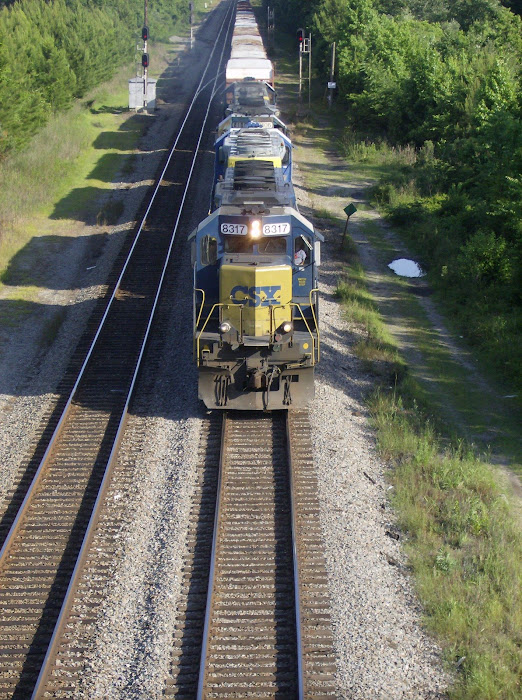
I was running some errands in Callahan today when the headlights of a NB CSX engine shinning off in the distance on the Baldwin-Callahan sub caught my eye. By the time I stopped, grabbed my camera and looked through my lens, I noticed the train was stopped probably at milepost 18 on the Crawford slope. I then looked to my right down the main line toward Folkston and noticed a maintenance of way truck welding on the west track just north of the cross over. Beyond them was an oncoming SB manifest slowly rolling toward the CR 108 grade crossing. The gates went down, much to the frustration of the drivers who were heading west toward Callahan Immediate School to pick up their kids. Once that train past, the headlights of the NB train on the Baldwin-Callahan sub began flashing, signalling its start up toward the junction. I got a couple of head on shots before 6 CSX engines pulling a manifest full of old gondolas and grain cars rounded the curve and slowly crawled through the grade crossing, blocking a line of huge yellow school buses heading east from Callahan Intermediate. The locomotives creeped onto the mainline and through the crossover as the maintenance crew stepped back. The flanges of the slow turning wheels creaking and clanging against the sharp curve of the sub and the cross over is something you don't hear much in Callahan. I wish I had a sound recorder that could capture those sounds that you don't usually hear from most trains racing through Callahan at top speed. Some of the freight cars had to be as old as I am; the names of the original railroads long faded beyond legibility. The final dozen or so cars were empty auto carriers, making their own unique banging sounds, its sides painted with the urban graffiti that seems to have become an art form of its own. Once that train cleared the track workers, a SB inter modal train crawled through the grade, followed by another SB manifest that took the sub toward Baldwin. I am sure the slow speed that the engineer of the inter modal train had to killing him as those trains usually are racing through Callahan as they try to beat the closing times of the ports in Jacksonville. All in all, having a quartet of trains traveling at unusually slow speeds was a nice change of pace from the normally high speeds in which they normally travel trough the Callahan.
Subscribe to:
Posts (Atom)